Grace to you and peace from God our Father and from the Lord Jesus Christ his son. Amen.
The Wedding
The first wedding I performed as a pastor was for a couple that I knew through a Star Trek club. Specifically, Starfleet International.
Yes, I was once a card carrying member of Starfleet International.
Steve was Jewish and Dixie was Presbyterian.
And because they had moved recently from the area I knew them from, we had to do all of our wedding planning over the phone.
The wedding would be held on a Friday night before sunset, before Shabbat began or the Sabbath.
I began to ask Steve about planning for a rite that involved bread and wine.
And Dixie, not understanding what I was talking about, cried out, we’re not having communion.
It’s not Communion, it’s Shabbat…
Steve quickly explained that the right for ushering in Shabbat Begins with a traditional blessing over bread and wine.
You lift up the bread and you offer a prayer.
And then the bread is broken and passed around the room,
everybody ripping off a giant piece. Then a cup of wine is taken and it is blessed.
And then the cup is shared around the room with everyone taking a sip of the common cup.
It sounds like holy communion. And this is likely the same rite that Jesus used at the last Supper,
A rite that in the church has become holy communion and taken on a different meaning.
Baptism and the Jewish rite of Mikveh
Sometimes we forget how close we are to our Jewish brothers and sisters and our rights and our and rituals.
And the same is true for baptism, the second sacrament in the Lutheran church.
Today we celebrate the baptism of Jesus, a feast day in the church.
Baptism as we know it began in the Jewish custom of the mikvah.
The mikvah was a ritual bath used by men and women to make themselves ritually clean. It’s still used today.
Often it was a small pool filled with living water. Living water was any water that flowed from a stream or river.
It could also be rainwater freshly collected.
The Reformers in the wilderness
Now, the first five books of the Bible tell us very many ways when we need to go and become ritually clean.
We would need to go to the mikvah if we had come in contact with blood or other bodily fluids,
if we had touched a dead body, or even come in contact with someone who was considered unclean.
But during the time of Jesus, a small reform movement began within Judaism in the wilderness.
These people that gathered in the wilderness taught that what makes us unclean is not blood or death or anything we touch or eat.
They taught that what makes us unclean is what comes out of our hearts. Green greed, maliciousness and hate. This should sound familiar to you because this is what Jesus tells us in Mark chapter 7 and Matthew chapter 15.
Jesus said to them, so are you still without understanding? Do you not see that whatever goes into a person from outside cannot defile? It is what comes out of a person that defiles. For it is from within, from the human heart, that evil intentions come. All these evil things come from within, and they defile a person.
This reform movement promoted daily repentance and baptism, ritual washing in a mikvah in order to be in a better relationship with the divine. And biblical scholars wonder what John the Baptist’s relationship was to them. Was he a part of this group or was he merely influenced by their teachings? But either way, his teachings echo what we know about this group, reformers in the first century.
Repentance
Now, John, like this reformed group, preached a baptism of repentance, which is not the same baptism that we celebrate today.
If you were to go back and read Matthew chapter 3, verses 1 to 12, which comes before the selection we’ve read today,
you will hear John use the word repent or repentance three times.
But if we look back at the Greek, the word that we translate to repent means something a little bit differently than the way we talk about repent today.
When we talk about repentance, we mean quit your sinning, you know, acknowledge your sin, come to Jesus for forgiveness.
But repentance in Greek means more of change your way of thinking, open your mind.
The word is metanoia, meta, you know, like metamorphosis, you know, change.
Jesus is baptized
So Jesus came from Galilee to be baptized by John. And we have this whole struggle of John saying,
I don’t want to do this. I mean, you should baptize me. And I think this.
Remember that the Gospels are written much later and that this is not included in Mark’s version of the baptism.
In fact, Mark’s version of the baptism is. And Jesus was baptized by John and then went to the wilderness.
But the church struggled, the early church struggled with why did Jesus need to be baptized? Jesus didn’t need to repent. And so we have this explanation.
We’re going to do this to make sure we’re going to do it for the right reasons.
You are my beloved son
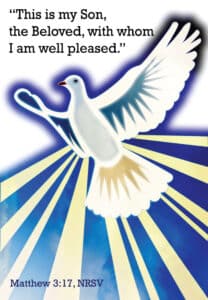
And then during his baptism, we hear the voice of God saying, You are my beloved Son, with whom I am well pleased.
And this is the moment that Jesus’s ministry begins.
The ministry of Jesus begins with God claiming Jesus as his Son.
The Bible doesn’t tell us what Jesus was doing before he went to John, but we can imagine that he was a carpenter and working in his community.
Or many from the village of Galilee would go down to the big city, Sepphoris and work there.
So we can imagine that Jesus was just living his life as a carpenter until he comes to John the Baptist and God claims Jesus as his Son and everything changes.
The ministry of Jesus begins after his baptism.,
As the church grew, baptism became more than a call to change or open our minds.
It became the entry right into the church, something we do to give people membership in our congregations.
Baptism for God or for us?
And over time, we began to believe that baptism is something that we do to please God, something that we can only do after we believe.
This is the Baptist position, right?
That you don’t. You aren’t baptized until you can confess God as your Savior for yourself.
And we do this, and a lot of times we talk about it as earning our golden ticket to heaven.
But as Lutherans, we do not believe that this is something that we do for God.
We teach that baptism is something that God does for us.
In baptism, God claims us just as God claimed Jesus.
And God says, you are my beloved child with whom I am well pleased.
Just like I told the children, you are my beloved child with whom I am well pleased.
We are called
As Lutherans, we talk about the priesthood of all believers,
that God calls us to go out and continue the work which he began in Jesus,
to continue that and spread that throughout the world.
And our call to ministry begins when we realize that the divine creator of all things loves us as we are.
That, like Jesus, this moment of realization becomes a call for us to go out into the world proclaiming the good news that we are loved.
We are called to go out into the world and say, you are loved. God loves you.
This moment of clarity beckons us to discipleship.
This moment invites us to service, to serve one another and to seek justice,
which we heard in our confession and will hear when we leave today.
This invitation is not something we have earned.
Because, brothers and sisters, we are all sinners, every single one of us.
And every day we sin against God in thought word and deed.
By what we have left undone and by all we have done and all we have left undone.
And yet God’s love for us never wavers. Never.
There are no sins that can erode God’s love for us.
There are no mistakes so egregious that they can negate the declaration
which God makes to us in baptism, when God said, you are my beloved child with whom I am well pleased.
And that’s in Romans.
There is nothing in all of creation that can separate us from the love of God in Christ Jesus.
Nothing.
Sometimes I think we forget that in baptism Jesus calls us beloved child.
The Invitation
In baptism, we are invited. We are invited to go out into the world to be part of God’s redemption of the earth that doesn’t need us, right? It’s like asking a two year old to help you bake cookies. You know, you don’t need the help of a two year old to make cookies, do you? But you do it because you love them and you want them to have that experience.
So, brothers and sisters, seize the invitation, go out into the world, proclaim the good news of Jesus and remind the world that they are God’s beloved. Amen.
Sign up to receive our weekly newsletter via email