Forty Days
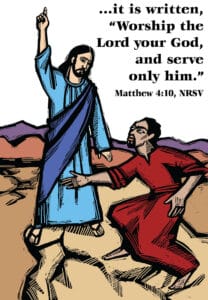

MATTHEW 4
Click here to watch sermon on YouTube
Click here to see the devotions based on this sermon.
Matthew’s Gospel tells us that Jesus was led by the Spirit into the wilderness to be tested by the devil, and that Jesus fasted for forty days and forty nights. Now it’s important for us to remember that Jesus was Jewish and that the author of Matthew’s Gospel was also Jewish, and that there is a lot of Jewish symbolism in our Gospel readings.
So with that understanding, I want to begin this morning with a quote from Rabbi Sari Laufer, who she serves as a rabbi at the Stephen Wise Temple in Los Angeles. She writes: “As it happens, 40 is not an insignificant number. In Jewish tradition, the great flood lasted 40 days and 40 nights. Moses spent 40 days on Mount Sinai before bringing the Torah to the people of Israel. And perhaps most significantly, our people spent 40 years wandering in the desert before we reach the Promised Land… In our tradition, 40 seems to be a span of time that invites discernment, if not quite fulfillment and understanding.”
40 is not an insignificant number.
And today our Gospel speaks of 40 days that Jesus spent in the wilderness, fasting in preparation for his ministry.
And today also marks the first Sunday in Lent, a season of forty days, plus the six Sundays where we prepare for the holiest of Christian days.
Rabbi Sari Laufer writes that in the Jewish tradition, forty seems to be a span of time that invites discernment.
I would also argue that the number 40 is connected to preparation and new beginnings. The flood prepares and sets the stage for a new beginning for humanity. The 40 years in the wilderness forces the Israelites to fully rely on God in preparation for their entry into the new land, the Promised Land.
And Moses on the mountaintop. For forty days, forty days is preparing to bring the new Covenant, the Torah, the Ten Commandments, down to the people.
And so this morning I want to reflect on how we will spend this season of 40 days.
Forty.
Every year we begin with the story of the temptation in the wilderness. Jesus spent forty days fasting in the wilderness being tested and tempted by the devil. The story reminds us that even Jesus experienced temptation and that the temptation to sin is always with us, always tempting us away from our heavenly Father, always, always promising us the world.
As Christians, we proclaim that the life, death and resurrection of Jesus saves us from sin and that we are already saved.
And yet at the same time, we acknowledge that until the day of Jesus Christ, save, sin will remain with us like a thorn in our side.
I’m thinking about that passage in [Second Corinthians.] I think it’s where Paul talks about having a thorn in his side.
We all experience that thorn in our side. As Luther said, we are simultaneously saint and sinner.
And until the day we are welcomed into our heavenly home, we will continue to be simultaneously saint and sinner. Simel Eustace Epicater.
Confession
On Wednesday night, people in churches all over the world gathered together, confessing that we have sinned against God in thought, word and deed by our own fault, by our own most grievous fault.
We confess that we have not loved God or our neighbor with our whole heart, that we have not forgiven as we have been forgiven. We admitted to not being true to the mind of Christ. We confess that pride, envy, hypocrisy and apathy have infected our lives.
We acknowledged that we ignore the suffering, the injustice and the cruelty of around us.
We are all sinners in need of God’s forgiveness, of God’s undeserved mercy. We need grace, all of us.
As Paul says in Romans chapter three, all have sinned and fallen short of the glory of God, even as he reminds us that we are saved in spite of ourselves.
For there is no distinction. Since all have sinned and fallen short of the glory of God, they are now justified by God’s grace as a gift through the redemption that is in Christ Jesus. This is the free gift that Paul writes about in chapter five, which Stephen read for us.
It is very easy to convince ourselves that we are good enough.
It is very easy to deny the ways in which sin eats at our relationship with God and eats at our relationship with our neighbor, with our loved ones, with the world.
But thanks be to God, through Jesus, we have the victory. We have been given the free gift of God’s grace, justified by Jesus and clothed in the robes of righteousness, not because we’ve deserved them, but because of God’s love for his people.
Think about that lost son in the story of the Prodigal Son, right? He has done nothing to deserve his Father’s forgiveness. And yet immediately his Father runs to him and puts a new robe on him, covering his sin, welcoming him back with a feast.
But even as we remember God’s forgiveness and God’s grace, we cannot ignore the ways in which sin constantly infects us.
And I see these forty days of Lent as an opportunity to reflect on the reality of sin in our lives.
One way to do this is to pick up a red hymnal and read through the confession we said together on Ash Wednesday. It’s in our hymnals under the Lent and the Three Holy Days.
You could journal about the ways that you see sin in your life.
You could read through the Small Catechism again. It may be a while since you’ve done that. Or review the Sermon on the Mount in Matthew’s Gospel and reflect on the ways in which Matthew defines the sins of murder and do not commit adultery.
Jesus says, if you call your neighbor a fool, you have committed murder.
If you even look at someone the wrong way, you are committing adultery in your heart.
This Lent let us take an honest assessment of ourselves, not in order to berate ourselves or to shame ourselves.
I invite you into a season of reflection so that we can fully appreciate the gift of grace that we have received through the life, death and resurrection of Jesus.
Lent is a time to prepare us for the joy and the wonder of Easter, of the resurrection of Jesus, who declares to us that death will no longer have any power over us. We are forgiven, we are saved, and our salvation is not dependent on our goodness.
Our salvation is dependent on the goodness, the grace, and the mercy of our Lord God through Jesus Christ, Amen.